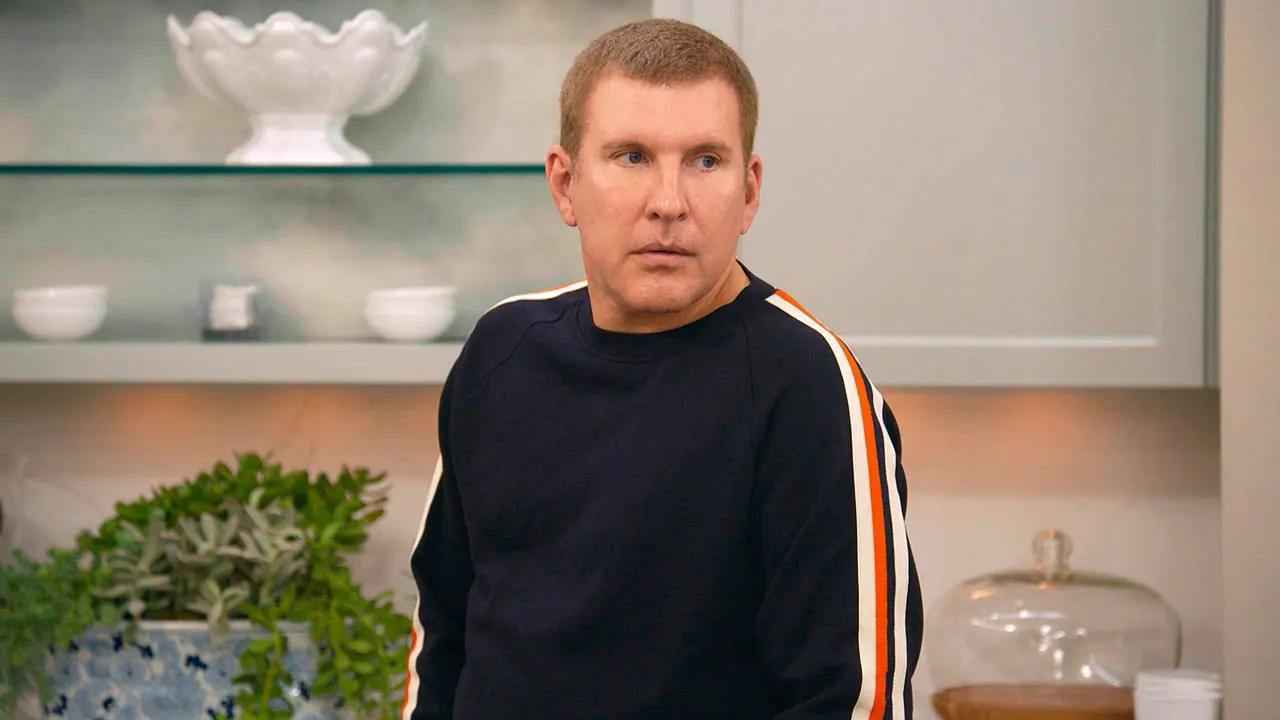
Very Sad News: Todd Chrisley Punished by Facility with No Church – Shocking Consequences!
The world of Chrisley Knows Best has always thrived on larger-than-life personalities, outspoken family dynamics, and an unwavering emphasis on faith, family,
and resilience. But now, that very foundation is being tested in a deeply emotional and controversial way as reports emerge surrounding Todd Chrisley and
an alleged punishment inside federal custody that has stunned fans: restricted access to church services.
For a man long defined by his public devotion to Christianity, the idea that Todd Chrisley may be barred from attending worship has ignited intense debate, emotional reactions, and renewed scrutiny of life inside the facility where he is currently serving time.

A Faith-Centered Identity Under Pressure
For years, Todd Chrisley has presented himself as the outspoken patriarch of the Chrisley family—confident, opinionated, and unashamedly anchored in his Christian faith. Whether on television or in interviews, he often emphasized that prayer, church attendance, and spiritual discipline were non-negotiable parts of his life.
That is precisely why these latest reports have struck such a nerve with fans.
According to recent claims circulating through interviews and social media commentary, Todd Chrisley has allegedly been denied access to church services inside the facility where he is being held. While details remain disputed, the allegation alone has triggered widespread concern among supporters who view faith as central to his identity and coping mechanism during incarceration.
For someone who built much of his public persona on moral conviction and religious routine, the restriction is being described by fans as more than a punishment—it is, in their eyes, a spiritual disruption.
Inside the Allegations: Church Access and Facility Restrictions
The controversy escalated following interviews conducted with journalist Brian Entin, where Todd Chrisley reportedly addressed conditions inside the facility and raised concerns about treatment, resources, and daily restrictions.
Among the most striking claims is that Chrisley and other inmates may have been prevented from attending scheduled worship services after staff allegedly suspected unauthorized communication or contraband activity. According to the narrative circulating online, confusion surrounding a prior recorded interview contributed to heightened security responses, ultimately affecting access to the chapel.
The result, as described in these reports, was missed church attendance—an outcome that supporters argue carries emotional and psychological weight far beyond a standard disciplinary measure.
For critics, however, the situation remains unclear, with many emphasizing that prison regulations are strict by design and apply universally, regardless of a prisoner’s public profile.
A Wider Pattern of Complaints
This is not the first time concerns have been raised regarding conditions inside the facility. Earlier discussions linked to Todd Chrisley’s interviews referenced allegations involving food quality, healthcare limitations, and sanitation issues.
In previous statements attributed to him, Chrisley suggested there were systemic shortcomings affecting inmates’ daily lives, including claims of inadequate medical staffing and delays in treatment. One of the more alarming accounts involved an alleged medical emergency where an inmate with medical training reportedly assisted another prisoner before professional care arrived.
While these claims have not been independently verified, they continue to circulate widely among fans and media commentators, adding fuel to an already heated conversation about incarceration standards.
The Emotional Core: What “No Church” Means for Todd Chrisley
Beyond the logistical debate lies a more emotional question: what happens when a deeply faith-driven individual loses access to structured worship?
Those close to the situation suggest that this is where the impact becomes most profound. For Todd Chrisley, church has never been just a weekly routine—it has been a stabilizing force throughout personal, financial, and legal turbulence.
His wife, Julie Chrisley, has also frequently spoken about the family’s devotion to shared prayer and spiritual guidance. Sources close to the family indicate that efforts may have been made to request accommodations for religious practice, though institutional policies and administrative barriers reportedly complicate such arrangements.
Without access to communal worship, Chrisley is said to be relying on private prayer, written devotionals, and informal spiritual discussions with fellow inmates as alternative coping mechanisms.
Family Impact and Public Reaction
The Chrisley family has long been a central part of American reality television culture, and any development involving its members quickly becomes a public conversation.
Fans have expressed a wide range of reactions—some emotional, others critical. Many supporters argue that restricting access to religious services could have a serious emotional toll, particularly for someone who has consistently framed faith as a cornerstone of personal survival.
Social media platforms have become a battleground of opinion. Some users describe the situation as unfair or unnecessarily harsh, while others insist that incarceration inherently comes with limitations, regardless of personal beliefs or fame.
The divide reflects a broader cultural debate: should spiritual practice be treated as an inviolable right within correctional systems, or as a privilege subject to institutional discretion?
A Legal Battle Still Unfolding
Adding another layer of complexity, Todd Chrisley’s broader legal situation continues to evolve. Reports indicate that appellate proceedings remain active, with future hearings expected to address aspects of his conviction and sentencing.
Observers note that cases involving white-collar convictions often draw heightened public attention when they involve well-known figures, particularly those with strong media presence. Chrisley’s situation is no exception.
Supporters speculate that his public statements and interviews may also be part of a broader effort to highlight prison conditions and potentially advocate for reform, though no formal confirmation has been made regarding any such campaign.
Faith Behind Bars: A Psychological Perspective
Experts in correctional psychology often emphasize the importance of structured spiritual practice in maintaining emotional stability during incarceration. Religious participation can provide routine, community, and meaning—all critical components of mental resilience in restrictive environments.
If access to communal worship is limited, psychologists suggest that inmates may experience increased isolation, frustration, or emotional strain, particularly if faith previously played a central role in their identity.
In Chrisley’s case, this dynamic is intensified by his public persona. Unlike most inmates, his experience is not private—it is continuously interpreted, debated, and amplified by a national audience.
Resilience in Isolation
Despite the controversy, sources suggest that Todd Chrisley continues to adapt. Reports describe efforts to maintain structure through informal spiritual leadership, including group discussions and encouragement among fellow inmates.
While these alternatives may not replace formal church services, they reflect an attempt to preserve continuity in faith practice under constrained circumstances.
This adaptability has long been a defining trait attributed to Chrisley—whether navigating financial setbacks, family challenges, or legal battles, he has often been portrayed as someone who responds to adversity with vocal conviction and persistence.
The Bigger Question: Punishment or Policy?
As the discussion continues, one central question remains unresolved: is this situation an intentional disciplinary measure or simply a byproduct of institutional procedure?
Without official confirmation, interpretations vary widely. What is clear, however, is that the story has struck a nerve far beyond the walls of the facility. It touches on themes of faith, punishment, rights, and the emotional reality of incarceration for high-profile individuals.
Final Reflection
At its core, this unfolding situation is not just about one man’s access to church. It is about identity, belief, and the struggle to maintain spiritual grounding in one of the most restrictive environments imaginable.
For supporters of Chrisley Knows Best, the image of Todd Chrisley separated from the very institution that has long defined his public life is deeply unsettling.
Whether this restriction is temporary, procedural, or part of a broader pattern remains unclear. But what is certain is that the conversation surrounding faith, fairness, and prison conditions is far from over—and Todd Chrisley’s story continues to be watched with intense public interest.