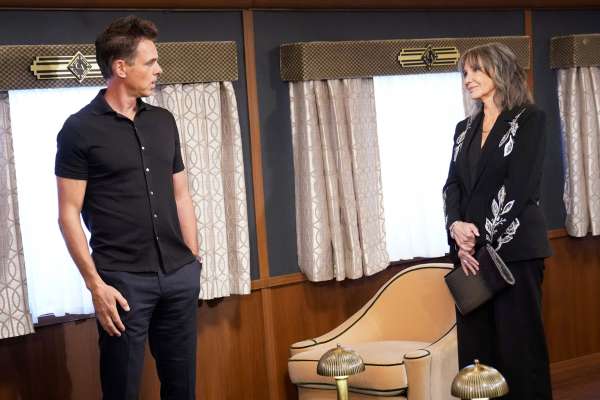
Billy Ignored Jill’s Call—But He May Have Already Started Chancellor’s Most Dangerous Power War
Sometimes the biggest story isn’t the secret someone is hiding. Sometimes it’s the moment another person decides that silence is no longer acceptable. That may be exactly where The Young and the Restless is taking Billy Abbott. After returning from London, Billy didn’t storm into Jill’s office demanding answers. Instead, he quietly turned his attention toward Chancellor’s history. Then came an even more intriguing moment: Jill called, and Billy never answered. The recaps never reveal what Jill wanted to say, and they never confirm that she is hiding anything at all. Yet Billy’s choices suggest that the real conflict may no longer be about discovering a secret—it may be about igniting a power struggle that no one saw coming.
Billy’s first move is what makes this storyline so fascinating. Rather than confronting Jill directly, he begins researching Chancellor’s past on his own. That decision says far more than any accusation ever could. If Billy simply wanted reassurance from his mother, answering her phone call would have been the obvious step. Instead, he appears determined to verify every suspicion independently. His investigation is aimed at the company’s history rather than at Jill herself, suggesting that he believes the answers, if they exist, are buried within Chancellor’s legacy rather than in a single conversation.
The missed phone call only deepens the tension, even though the recap carefully avoids explaining its significance. There is no indication that Jill intended to confess anything. She may have wanted to explain Billy’s concerns, calm his fears, discuss something completely unrelated, or simply reconnect after his return. The audience doesn’t know, and neither does Billy. What matters is not what Jill might have said, but what Billy chose to do instead. By ignoring the call, he effectively placed his own instincts above his mother’s words. That decision could become the emotional turning point in their relationship long before any hidden truth is revealed.
Perhaps the most overlooked detail is what Billy actually investigates. He doesn’t search through personal records. He doesn’t chase family history or private documents. Instead, he studies the history of Chancellor itself. That distinction changes the entire conversation. The story suddenly shifts away from speculation about private family matters and toward the evolution of one of Genoa City’s most influential companies. Billy’s curiosity seems focused on understanding how Chancellor became what it is today rather than proving that Jill committed some hidden deception. That subtle difference keeps the storyline grounded while opening the door to much larger possibilities.

Ironically, Billy may not be searching for a secret at all. He may be stumbling toward an old power struggle that has been dormant for years. Every major company develops through difficult decisions, shifting alliances, competing visions, and moments that shape its future. If Billy continues digging into Chancellor’s past, he could begin questioning decisions that were never meant to become today’s battleground. None of that requires Jill to be hiding a dramatic revelation. Instead, Billy’s investigation alone could resurrect long-forgotten tensions and force old disagreements back into the spotlight. In that scenario, the danger doesn’t come from exposing a secret—it comes from reopening conflicts that everyone assumed had already been settled.
That possibility becomes even more compelling because Billy’s investigation produces no immediate breakthrough. According to the recap, he doesn’t discover any shocking documents or uncover new evidence. On the surface, his research leads nowhere. Yet that apparent failure may actually strengthen the storyline. If the historical record offers no obvious answers, Billy’s growing determination could become the real catalyst. The longer he searches without results, the more likely he is to question people, challenge assumptions, and revisit events that others would rather leave untouched. The absence of evidence may encourage him to dig even deeper, creating friction long before he finds anything concrete.
This approach also makes Billy’s storyline feel different from many previous corporate conflicts. Instead of reacting to someone else’s move, he is creating momentum through his own decisions. Every step he takes is voluntary. Every new question originates with him. Whether his suspicions ultimately prove correct almost becomes secondary. Once someone begins revisiting an institution’s history with fresh eyes, the consequences can spread far beyond the original question. Colleagues become defensive. Relationships become strained. Every conversation carries new weight because everyone wonders what Billy will ask next, not because anyone has already been exposed.

For now, the recaps remain remarkably careful. They never state that Jill is concealing a specific truth, nor do they identify any concrete revelation waiting to be uncovered. Billy himself finds no new evidence after researching Chancellor’s history. Those facts are important because they keep the story rooted in possibility rather than certainty. Still, Billy’s actions may already have changed everything. By choosing investigation over conversation and history over reassurance, he may have set a much larger conflict into motion. If this storyline continues in that direction, the biggest surprise won’t be what Jill was hiding. It will be the realization that Billy’s relentless search for answers sparked a Chancellor power war that no one—including Billy himself—was truly prepared to face.